How to Take Smart Notes - Sönke Ahrens
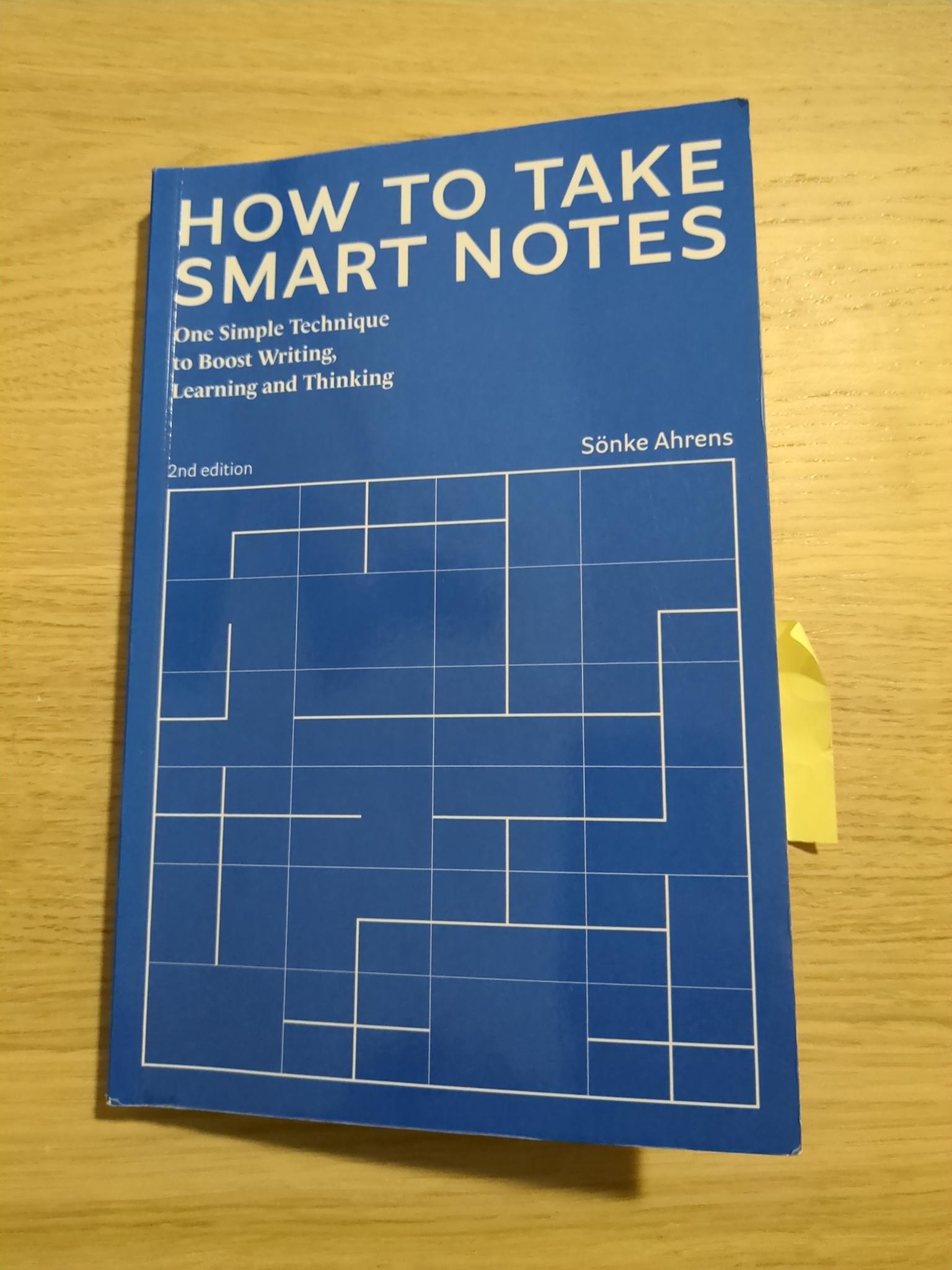
How to Take Smart Notes by Sönke Ahrens. The second edition of the book, to be specific. Reason for my tardiness is that I didn’t enjoy the experience or what I got out of it. Which, frankly, is a pity.
Predominantly, the bulk of my leisure reading material is of the fictional persuasion. So this entry was a departure from my typical mileau. My initial interest in this book came from three different angles:
- First, the promise or payout of the “Zettelkasten” method as a catalyst for taking notes and personal knowledge management.
- Second, because I’ve been bombarded by “experts” in this productivity and knowledge management area left and right. Clamoring for intricate systems and applications for second brains, personal management, and general productivity. Probably The Algorithms™ and their recommendations are to blame.
- Third, this is a unicorn in publishing terms. It is a highly successful self-published book, boasting more than 100’000 copies sold!1 Translated to numerous languages to boot. I went into the work knowing that it has had celebrated popularity, and found its niche audience.
But why did this book suck the wind out of me, and leave me completely deflated?
Let’s circle back, and start from the beginning.
The Book, In Short
The book promises students, academia staff, and other non-fiction writers a magical system to organize their notes, be more productive, and reach uncanny levels of quality output work.
All of this is based on the principles of the Zettelkasten, popularized by German academic Niklas Luhmann, a sociologist of note in the 20th century. (Sidenote: far from the first academic using this method, but I digress).
Zettelkasten is the German word for “slip box”, since originally the method used analog index card stored in such an implement. Of course these days we can rely on a myriad of digital software options, that ease several steps of the process.
In a nutshell, the method consists of the following steps:
-
Capture fleeting notes. These are any thoughts, ideas, quotes, sparks, or general notes you collect throughout your day. They shouldn’t be too polished or elaborate, up to a few paragraphs at most.
-
Capture literature notes. Which could come from a piece of literature you are reviewing, or an academic paper, newspaper article, or similar. The most important note here, repeated ad nauseum throughout Ahrens’ book, is to write the key points in your own words.
-
Transform 1 + 2 into permanent notes. Once per day/week/month (Ahrens recommends a daily cadence) we should review our fleeting and literature notes and consolidate them into permanent notes. When doing so, we should keep in mind if this new note(s) are connected to previous ones in our Zettelkasten, and if so link them appropriately. Permanent notes should be concise, and atomic.
-
Retrieve and remix. On 3, our notes are linked by topic, author, theme, ideas, we can retrieve them when wanting to create some output (an academic paper, a book, a blog post). Since the bulk of the work was already performed in the past whilst absorbing sources, we have a very solid starting point. Moreover, since notes can have several links to various tangent topics, we can create more varied and novel arguments. Contrast this to a more “traditional” and linear method, which Ahrens repeatedly belittles.
Peeling the Onion Off
Onion? What onion?
Don’t get me wrong. There are some good ideas throughout the book. But it did feel like a shallow echo chamber of a snake-oil seller at times. Despite its shortness clocking 147 pages with relatively big font (appendix excluded), it felt repetitive and disjointed.
My first problem with it, is its target audience. I am not it, and probably you aren’t either. It is definitely focused on academia, or students following a tracked curriculum in a non-STEM field. For an average reader like myself, in the industry, how does this help in daily life?
The principles are solid when engaging with non-fiction (see steps 1. to 4. above), but are little more than generic axioms. So the second problem is its shallowness. Vague principles are explained at surface level, but we miss concrete examples and evidence that this method is applicable by anyone committed.
For instance, I was really interested in the topic of interlinking notes, using tags/keywords. Software solutions (e.g Obsidian) could then make then retrieval a breeze. This is what the book had to say about this:
Keywords should always be assigned with an eye towards the topics you are working on or interested in, never by looking at the note in isolation. This is also why this process cannot be automated or delegated to a machine or program - it requires thinking.And then…
It is important to always keep in mind that making these links is not a chore, a kind of file-box maintenance. […] Instead of figuratively searching our internal memory, we literally go through the file-box and look for connections. By dealing with actual notes, we are less prone to imagine connections where there aren’t any, as we can see in black and white if something makes sense or not.Right, that is generic advice that does not help me further understanding this key aspect of the Zettelkasten method.
Moving on, my third problem with the book is its disjointed organization. A ruthless editor would have shot this manuscript to the sun. The examples are relegated to an Appendix, never mentioned in the text proper. The introduction is almost a quarter of the book.
Sigh
Moving On
This is a short review. I really don’t feel like dissecting something I enjoyed this little. In short, don’t read this book.
If you are mildly interested in the topic, search on Youtube a summary of the book, and browse a few books on the Zettelkasten method. That will be a much better use of your time.
As for me, at least I took two things out of the book, so it has that going in its favor:
-
When reading non-fiction, you can take notes on separate index cards (if tangential to the text), or post-it notes (to highlight quotes).
- Rationale: marking a book often results in forgotten insight. Index cards and post-its can be extracted with almost zero effort. And yes, I have no qualms on cannibalizing a physical book.
-
Popularity of a book is no indication of its quality, also in the self-publishing world.