A Gentleman in Moscow - Amor Towles
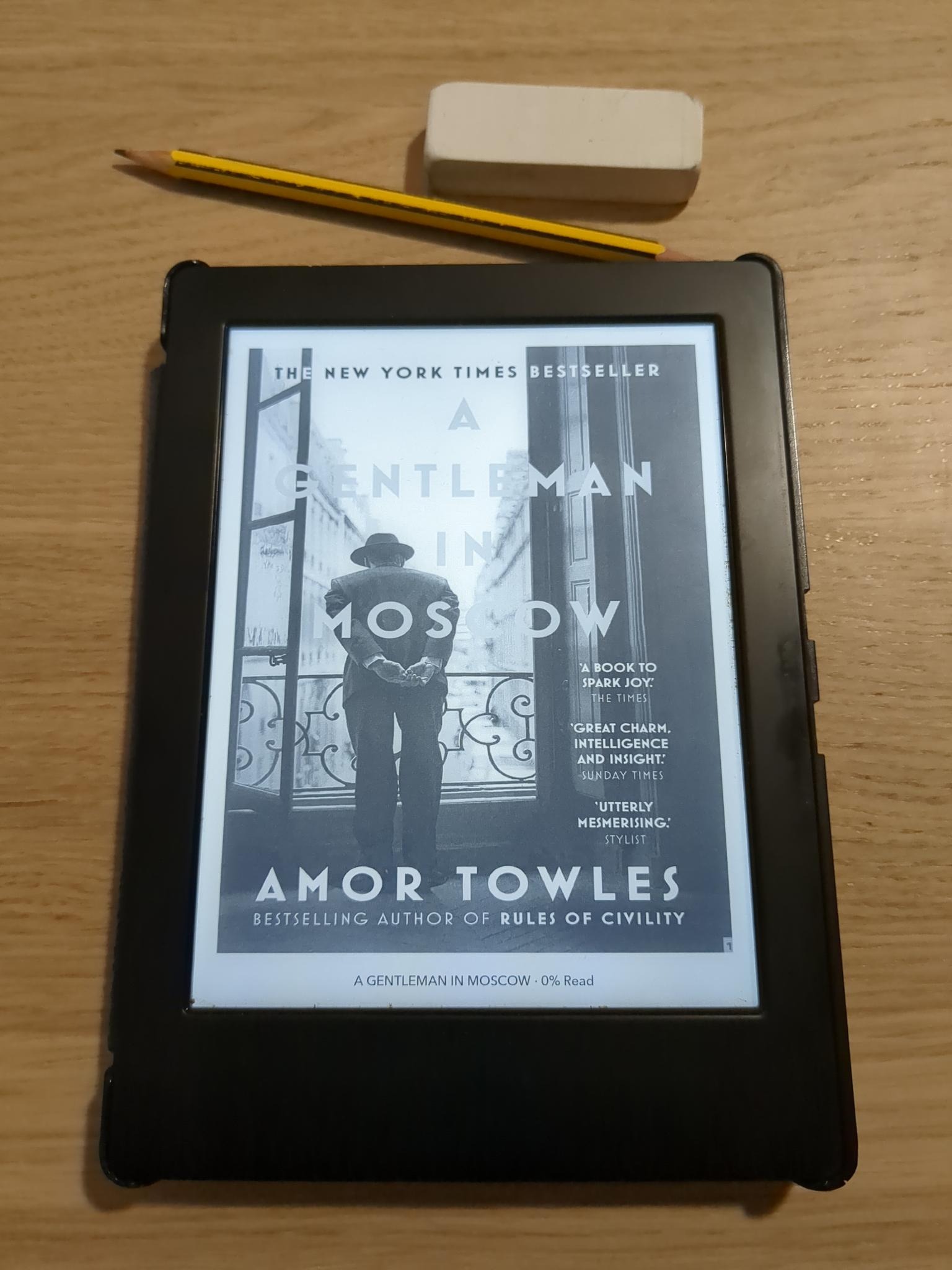
As promised, let me tackle the first installment from the 13 books I will be focusing on in this 2023. For January, this is A Gentleman in Moscow by Amor Towles, first published in 2016. I perused the digital version, as below.
The Book, In Short
Count Alexander Ilyich Rostov faces trial and is sentenced to house arrest in 1922 Russia, after the Bolschevik revolution. The Metropol Hotel is his residence, where we get to know him and an ensemble of charismatic characters at sampled moments over the course of several decades. A subtle historical background and attention to colorful descriptions permeate this tale of character and growth.
Who is this book for? Romantics. Those interested in the tumultuous 20th century in Russia, as seen from the sidelines. Lovers of the Classics.
Beware, spoilers ahead!
My Impressions
- The Count: Rostov is a character greater than life, and a case study of how to write a protagonist. Towles managed to make him virtually flawless, yet still relatable and empathetic, and I thoroughly enjoyed every second with him. Enjoyment of this book will come from your tolerance towards Rostov.
- Time and Space: The individual chapters are sampled in time, so we get a macroscopic view counted with microscopic detail, of events in Rostov’s life. Historical events permeate the background, but more as a background or as a vehicle for conflict. For instance, WWII gets a passing remark, although we see the dire consequences it has in Mishka. The center stage of the Metropol hotel is a constant of the book, with three notable exceptions.
- Political Turmoil and Class: The burgueoise versus the proletariat. The Bishop ascending the ranks through sheer partisanism. Rostov making good use of his contact and friendship with Osip Ivanovich Glebnikov, the Georgian official. It is ever so subtle, yet so obvious.
- … But Mundane in Nature: But what make this novel so relatable is that many of Rostov’s situations are Human in nature, and independent of his confined status. Embracing the rythmic routine. His love for cuisine and enology. His sporadic but evolving friendship with Osip. Sofia’s coming of age.
Review and Notes
The reading was pleasently enjoyable. Towles crafted a character in the Count that in most instances should have come across as pedantic and insufferable, given his apparent presentation as an almost flawless individual. He knows every piece of classical literature and music. Can name every wine in his sleep. Is all class and panache. Yet Towles managed to make him charming and relatable.
On Change
From the opening, Rostov’s house arrest makes him frozen in a bubble. And he is indifferent to his new reality at the Metropol until the incident at the barber, where he ends up slicing his moustache as a statement of change. The brutality of the risen through the Revolution awakens the Count to the reality of his new position.
He later on discards a suicidal attempt by a fortuitous encounter with Abram, the hotel’s handyman, on the roof, and takes on the position of headwaiter at the Boyarsky.
Although the Count and other characters are fictional, the Metropol is a real hotel. And a character of its own. Towles crafted vivid descriptions that transported me to the era the book was set at (even though this was fiction, it sometimes felt like a tale of real, transpired events).
As much as disposing of his title was an official affair, Rostov is reminded throughout of his position in the past regime. He has to navigate a dual society, where a form of tyrannical and injust power (the Tsars) is replaced by one more ruthless and byzantine.
On Chance
If this book tries to hone one thing, is that small decisions matter:
- Meeting Nina in adulthood results in Sofia staying back, and Rostov becoming a father.
- Correcting the Bishop whilst he was but a novice waiter created a future antagonist, when he climbed the political ladder.
- Richard Vanderwhile turned out to be a powerful contact to have, ultimately saving Sofia. And he came from a rather embarassing and fortituous encounter in the Metropol.
On Friends, Family and Women
An old friend, Mishka turns out to be the oppressed scholar. The Bulgakov. As someone vocal with a hint of brightness and critical thinking, he ends up being transformed in Siberia. We learn that the opening poem that saved the Count was his crafting. Yet careful reading reveals that Rostov never lied during the trial:
Vyshinsky: [Holding up a pamphlet] Are you the author of this long poem of 1913: Where Is It Now?

Rostov: It has been attributed to me.

Vyshinsky: Why did you write the poem?

Rostov: It demanded to be written. I simply happened to be sitting at the particular desk on the particular morning when it chose to make its demands.
Lastly, Nina and Sofia are the joys of his life. The former serves as an avatar of the dead Helena, for whose death Rostov feels a sense of responsibility, to which he acts as an older relative constantly enrolling in chicanery. It gives him a sense of richness within his confinment. The “master key” serves as a cheap device to solve some incongruencies in the plot later on, but it didn’t irk.
Sofia comes abruptly, and sets a genuine father-daughter relationship. When Sofia gets injured, the Count sets aside all his worries about Russia, brutalism, and national identity. It is the first time in over 20 years where he steps out of the hotel, without a flinch. We forget about our mundane problems the second someone we deeply love is in danger or hurt. It is Human nature.
Anna Urbanova is progressive, educated, artistic, with a humble beginning, and a contrast to Rostov. She provides a genuine relationship that transcends the confines of the hotel, as demonstrated by the ending, and I am glad she was more than a simpleton romantic affair.
Then, Anton and Emile, who form a Triumvirate and are characterized enjoyably and through quirks and physical attributes. And got a bit of dimension to themselves.
In Sum
The plot is fairly straightforward, and there are enough interesting nuggets for the avid reader, in the from of references, sprinkled throughout.
The book should have been 50 to 70 pages shorter. I as a reader also felt frozen in time for some passages, until the last quarter of the book, where pace picked up and action escalated exponentially.
Ultimately, and despite its period, this is a “feel-good” story, with no tangible villains. It is a celebration of life, class, humanity, and manners. A warning reflection about the atrocities perpetrated in the name of ideals. And how the former triumph over circumstances, social class, or time.
Some of my Favorite Quotes
Where the Count’s fate is set:
Thus, it is the opinion of this committee that you should be returned to that hotel of which you are so fond. But make no mistake: should you ever set foot outside of the Metropol again, you will be shot. Next matter.Not only the poem gets a center stage in the story. Montaigne’s essays appear repeatedly. So other works:
And the books? All of them! he had said with such bravado. But in the light of day, he had to admit that this instruction had been prompted less by good sense than by a rather childish impulse to impress the bellhops and put the guards in their place. For the books were not even to the Count’s taste. His personal library of majestic narratives by the likes of Balzac, Dickens, and Tolstoy had been left behind in Paris. The books the bellhops had lugged to the attic had been his father’s and, devoted as they were to studies of rational philosophy and the science of modern agriculture, each promised heft and threatened impenetrability.On war:
But in a period of abundance any half-wit with a spoon can please a palate. To truly test a chef’s ingenuity, one must instead look to a period of want. And what provides want better than war?On duels:
“Why is it that our nation above all others embraced the duel so wholeheartedly?” he asked the stairwell rhetorically.

 Some, no doubt, would simply dismiss it as a by-product of barbarism. Given Russia’s long, heartless winters, its familiarity with famine, its rough sense of justice, and so on, and so on, it was perfectly natural for its gentry to adopt an act of definitive violence as the means of resolving disputes. But in the Count’s considered opinion, the reason that dueling prevailed among Russian gentlemen stemmed from nothing more than their passion for the glorious and grandiose.
Critique:
Yes, thought the Count. That is it precisely.

For however decisive the Bolsheviks’ victory had been over the privileged classes on behalf of the Proletariat, they would be having banquets soon enough.
Nina as a child:
So,” said the Count, “are you looking forward to your visit home?”

“Yes, it will be nice to see everyone,” said Nina. “But when we return to Moscow in January, I shall be starting school.”

“You don’t seem very excited by the prospect.”

“I fear it will be dreadfully dull,” she admitted, “and positively overrun with children.”
On passing judgement:
After all, what can a first impression tell us about someone we’ve just met for a minute in the lobby of a hotel? For that matter, what can a first impression tell us about anyone? Why, no more than a chord can tell us about Beethoven, or a brushstroke about Botticelli. By their very nature, human beings are so capricious, so complex, so delightfully contradictory, that they deserve not only our consideration, but our reconsideration—and our unwavering determination to withhold our opinion until we have engaged with them in every possible setting at every possible hour.On the realization of Bolshevik change:
For years now, with a bit of a smile, the Count had remarked that this or that was behind him—like his days of poetry or travel or romance. But in so doing, he had never really believed it. In his heart of hearts, he had imagined that, even if unattended to, these aspects of his life were lingering somewhere on the periphery, waiting to be recalled. But looking at the bottle in his hand, the Count was struck by the realization that, in fact, it was all behind him. Because the Bolsheviks, who were so intent upon recasting the future from a mold of their own making, would not rest until every last vestige of his Russia had been uprooted, shattered, or erased.On loss:
Many years before, Andrey had visited Pushkin’s apartment in St. Petersburg—the one where he’d lived in his final years. The rooms of the apartment had been preserved just as they’d been on the day the poet died. There was even an unfinished poem and pen sitting on the desk. At the time, standing behind the little rope and gazing at the poet’s desk, Andrey had thought the whole venture rather preposterous—as if by keeping a few belongings in place, one might actually protect a moment from the relentless onslaught of time.

But when Ilya, their only child, was killed in the Battle of Berlin—just months before the end of the war—he and his wife had done the same thing: leaving every blanket, every book, every piece of clothing exactly where it had been on the day that they’d received the news.
On Stalin’s death:
Why, many Western observers wondered, would over a million citizens stand in line to see the corpse of a tyrant? The flippant said it must have been to ensure that he was actually dead; but such a remark did not do justice to the men and women who waited and wept. In point of fact, legions mourned the loss of the man who had led them to victory in the Great Patriotic War against the forces of Hitler; legions more mourned the loss of the man who had so single-mindedly driven Russia to become a world power; while others simply wept in recognition that a new era of uncertainty had begun.In closing:
“Looking back, it seems to me that there are people who play an essential role at every turn. And I don’t just mean the Napoleons who influence the course of history; I mean men and women who routinely appear at critical junctures in the progress of art, or commerce, or the evolution of ideas—as if Life itself has summoned them once again to help fulfill its purpose. Well, since the day I was born, Sofia, there was only one time when Life needed me to be in a particular place at a particular time, and that was when your mother brought you to the lobby of the Metropol. And I would not accept the Tsarship of all the Russias in exchange for being in this hotel at that hour.”