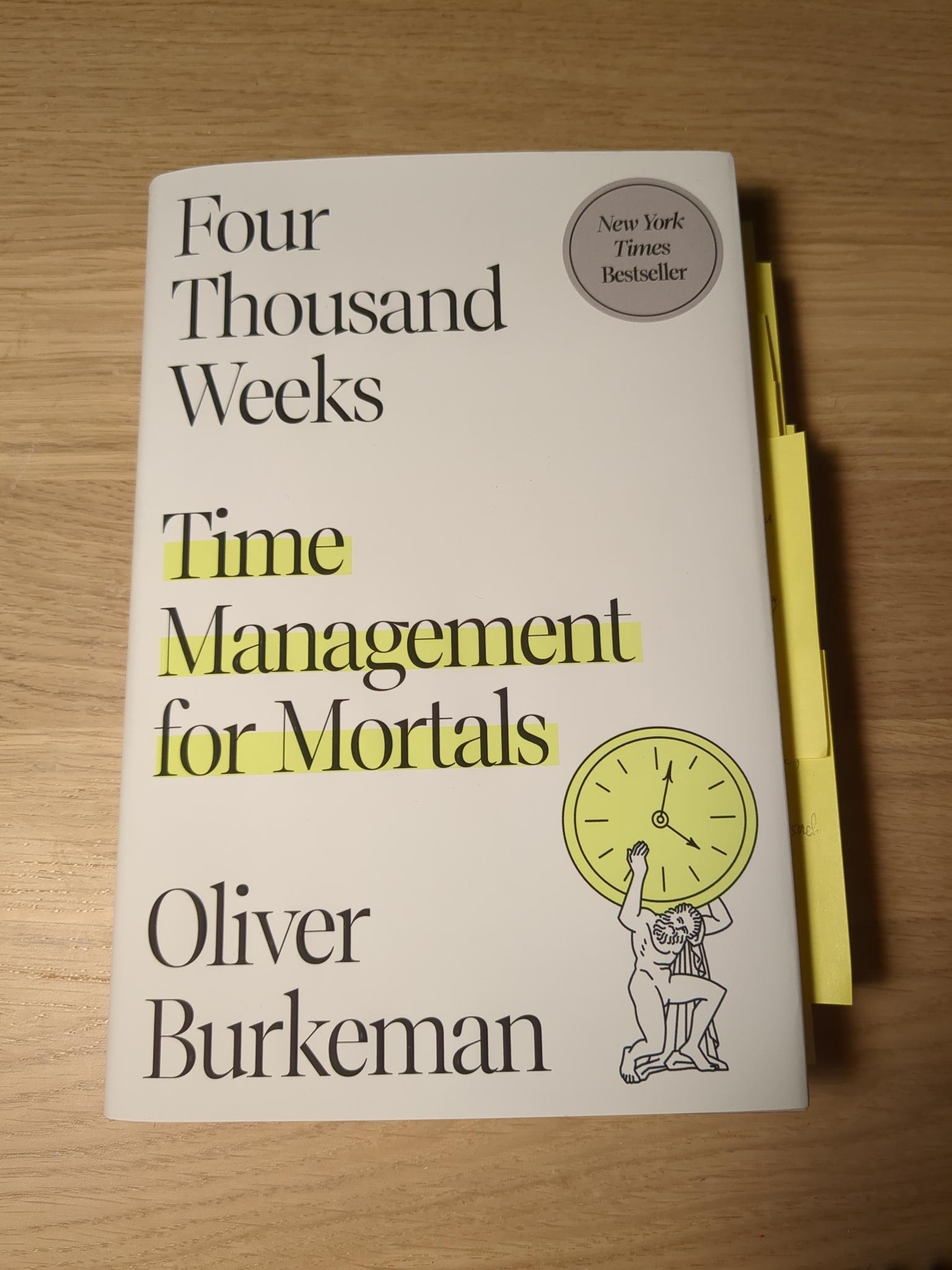
Four Thousand Weeks - Oliver Burkeman
When up to three people you love, admire, and respect point you to the same place, you would be a reckless fool not to stop, look, and listen with intent. Of course this phenomena should be treated with care and skepticism, to avoid unfortunate echo chambers from our environment. But after some recommendations and gentle pushes, this is how I arrived at Four Thousand Weeks by Oliver Burkeman.
Having gained significant traction, several accolades, and being a New York Times Bestseller, it has found its audience, and is definitely in the current Zeitgeist.
Normally in the broad category of what I consider “fluff” works, whose main takeaways can honestly be summarized in a few sheets of paper, I found myself rather enjoying certain points in this book, as well as its informal and personal tone.
The Book, In Short
Four Thousand Weeks: Time Management for Mortals opens with that as the number of weeks which we (in rough terms) should expect to live in a Western society nowadays. Roughly 80 years, plus minus. Now, with that concept of finitude in mind, Burkeman sets the stage, and asks: what should we do knowing this? Should we adjust our behavior? Or carry on?
There are key nuggets of information and lines of thought throughout the book, but Chapter 14 distills the key summary points in an elegant matter. Moreso, I found the five questions it presents (and we should constantly be asking ourselves, according to Burkeman) inspiring:
- Where in your life or work are you currently pursuing comfort, when what’s called for is a little discomfort?
- Are you holding yourself to, and judging yourself by, standards of productivity/performance that are impossible to meet?
- In what ways have you yet to accept the fact that you are who you are, not the person you think you ought to be?
- In which areas of life are you still holding back until you feel like you know what you’re doing?
- How would you spend your days differently if you didn’t care so much about seeing your actions reach fruition?
The book arrives at the conclusion that time management is a farce. The battle against time is already lost, before even starting. We should acknowledge that fact. The most important things we can work on create internal discomfort, and choosing distractions temporarily remove us from that friction. Goals worth pursuing require friction. Each time we seek distraction, what discomfort were we experiencing?
Industrialization and then 20-21st century Capitalism transformed our relationship with time, creating the illusion that it is just another commodity we can tap into.
Having hobbies where we are not good at, we have no ambitions, and we socialize with our peers, is paramount to our well-being. They should be slightly embarrassing, and we mediocre at them. Allowing ourselves freedom to pursue the futile. Because we are born with nothing, and we die with nothing.
Many of the underpinning principles presented in the book are closely intertwined with the popular trend of Stoicism. This is not a criticism on my side, just an observation.
I enjoyed is the informal tone of the text, peppered with anecdotes (which are extensively cited at the end of the book). There is also a lack of judgement or proselytism on us the readers. We are just invited to follow along the writer’s thought process, and come to our own conclusions.
In Practice, My Takeaways
Ok, that summary sounds pretty abstract. So what can we actually do, other than stare into the void and theorize? The Afterword: Ten Tools For Embracing Your Finitude on pg. 235 throws some ideas. Here what I might try for myself:
- Keep two to-do lists: A and B. A has the actual items that I actively work on, with maximum 4 items. B has everything and anything that comes in from my life, and should be done. Items might graduate from B to A if a slot opens up, but I accept that I will probably never get to 99% of what is recorded in B.
- Keep a done list. This is good for reflecting on past victories, celebrating the past, championing our past job performance for future promotions, etc.
- Stop caring: about current politics, the hottest new trend, the latest Netflix offering. Start caring: about your friends and family, reading/watching the Classics (books, films, plays, concerts), etc.
More Detailed Notes about the Book
Following are points that stood out to me from the book, in my own words. Read or skip at your own discretion:
- [pg.10] Keynes, 1930 “Economic Possibilities for Our Grandchildren”:
- By 2030 we were supposed to work 15h/week, that is 3 days at 5 hours, and maintain our level of wealth and prosperity. In 2023 we are still at 40+h/week.
- How much is the capitalistic mindset ingrained in at least three generations, to blame here? After WWII the maxim has been to work harder, get to greatness.
- [pg.18] Peasantry in the medieval ages sounds completely miserable. Was it? Did hardships mean misery or were people perfectly contempt within their situations? We are miserable in ways we can’t comprehend yet, and our great-grandchildren will think us brutes and barbarians.
- [pg.23] Mumford, 1934 “Technics and Civilization”
- In the Industrial Revolution (1800s) people used to work 6x per week, only resting on Sunday, day of God.
- Steam engines were vital, but having to coordinate factory workers in big hangars demanded a technical solution: the clock.
- First clocks (in the Western world) might have been invented by monks out of necessity. To keep up with night prayers. What about the East, or other parts of the World
- [pg.28] Using all these productivity methods, many widespread (Pomodoro, inbox 0, prioritization, Agile) give a false feeling on being on top of everything. Ultimately we feel overwhelmed, as the stream of inputs and tasks is never-ending. Realizing that these exercises are futile can bring some peace of mind. Which is ironic.
- Keeping ourselves busy holds back important/scary questions about life and major (vital) questions. E.g. we are never 100% ready to become parents.
- “Most of us invest a lot of energy in trying to avoid fully experiencing the reality in which we find ourselves”.
- [p.33] Anything we chose to do should bring joy, and remind us of everything we chose not to do and left out or cancelled. Avoid the temptation of “keeping your options open”, and commit irreversibly. It is probably better to do one thing well and fully committed than five multi-tasked messes with half our attention.
- [p.48] Any new tasks which come for consideration should be weighed against all other current tasks. Train and cut viciously and learn to say “No” to external requests. “Limitless reservoir for other people’s reservations”.
- It is very easy and dangerous to focus on the low-hanging fruit. Tasks that have low prio but are easy+fullfilling to do. Avoid that and focus on the uncomfortable meat instead. Stop clearing the decks, they will get filled again.
- [p.52] Inconvenience, to an extent, is a necessary friction point to show intentionality. Think of physical birthday card vs a digital message or e-mail.
- We sometimes don’t realize something is broken until someone shows us a better way.
- Inconvenience, coping, overcoming adversities as an inherently human trait.
- [p.73-78] Three main principles:
- Pay yourself first: If a certain activity really matters to you - creative project, nurturing a relationship, activism - make sure it will happen today.
- Limit your WIP: Fix a hard limit on number of things you allow yourself to work on at any time. Finish the projects you starts, or abandon them completely.
- Resist allure of middling priorities: Warren Buffet → take list of 25 things you want in life. Order them. Focus on top 5, and actively avoid the other 20. Those 20 are your demons.
- [p.86] Settling (a career, a relationship), is not inherently bad. On the contrary, it is a must. It is worth exploring the chosen path somewhat in depth, since what/who is out there represents infinite possibilities in our minds.
- That is a fallacy! Our time was, is, and always will be finite. We will be Settling. It is inevitable. We will have to choose between mutually exclusive options. The joy of missing out.
- [p.96] The problem with the social media apparatus of the 21st century is not that it “steals” our attention, but rather that it shifts it to where it wants. Interest and fear are created out of thin air, and without our conscious, rational consent.
- [p.105] Whenever we give in to distractions, we try to flee from a painful encounter with our finitude. Things that matter to us are hard/challenging/complex, and we fear failing at them. Because we have a very limited amount of shots to take!
- We value the task; failing at it would matter to us. And we have to confront reality instead of maintaining the fantasy of the unknown.
- [p.118] It is ok to plan ahead. But worrying excessively about the future is foolish: we may not even get there! So much uncertainty, so much chaos. We have to act in accordance to our goals, and look forward to future change/reward. But it shouldn’t cloud our judgement in the now.
- “All a plan is, is a present-moment statement of intent. The future is under no obligation to comply”.
- [p.133] The Last Time
- Events should be treated as if it’s the last time you are doing them, with a sense of reverence [Sam Harris]. Visiting our childhood home, talking to a close friend, visiting our favorite holiday destination.
- Let’s avoid treating moments as stepping-stones for the future (which may never come), and instead live in the present day.
- Capitalism saps meaning and enjoyment of the present to maximize wealth and returns in the future. “Capitalist pressure toward instrumentalizing your time saps meaning from life”.
- [p.143] There is a trapping in trying to optimize leisure time and its activities. Read books for profit, party for contacts, etc. Everything should be optimized and squeezed to its last drop. What about enjoying leisure for its own sake?
- We used to work more hours in decades past. But leisure was leisure. Now you are meant to have an end to any activity, even those outside of work.
- [p.165] Sometimes impatience is imposed on us as a social construct. If our job relies on answering forty emails an hour, we have to comply with those expectations to remain employed.
- [p.177] Watching at a single painting for 3 uninterrupted hours, as part of a Harvard’s art history class. Cathartic. Indulge in the luxury of waisting and observing. Cultivate patience. Endure the discomfort of not knowing. Let reality unfold at its own pace. Change the tempo.
- Patience in three principles:
- Develop a taste for having problems
- Embrace radical incrementalism
- Originality lies ont eh side of unoriginality
- Patience in three principles:
- [p.197] We need some societal structure to attain enriching hobbies (but some that are mundane, slightly embarrassing). And touch base with our loved ones.